Preservation Projects and Accomplishments
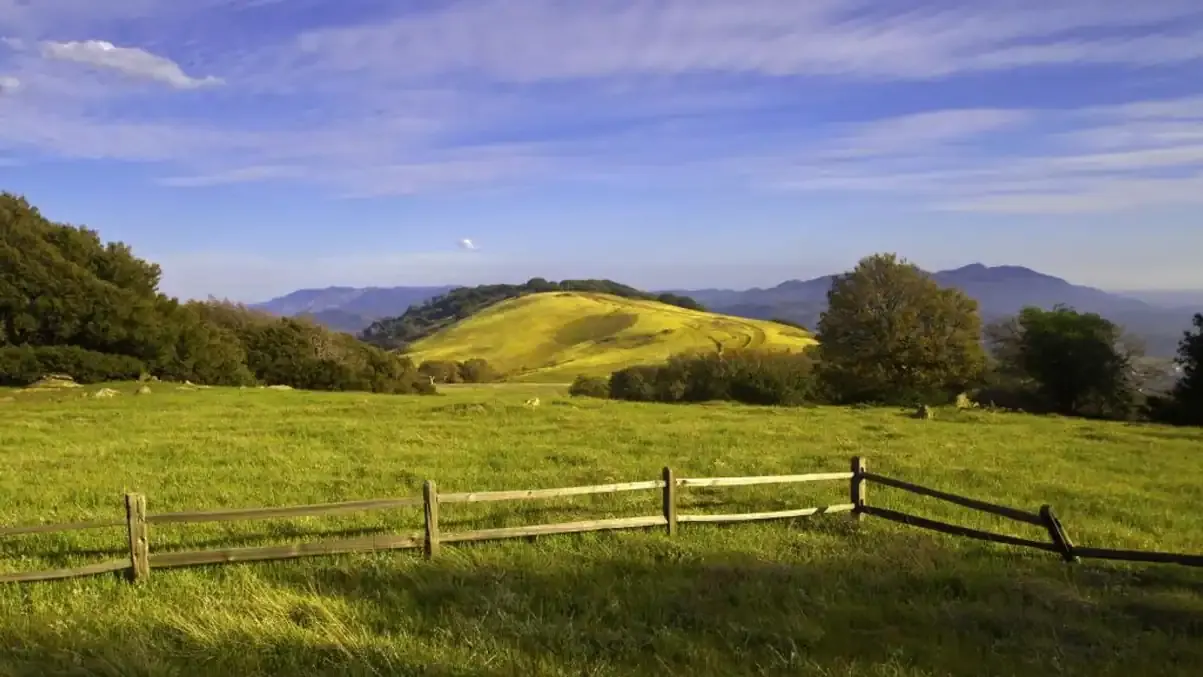
The foundation's Focused Planning Area (FPA) is on traditional Kumeyaay Land. Since 1989, through facilitation efforts of the Volcan Mountain Foundation (VMF) and its partners, more than 19,000 acres of land have been acquired from willing sellers, bringing conserved land within the range to approximately 44,000 acres.
| Agency | Approx. Acres |
|---|---|
| Volcan Mountain Foundation | 1,095 |
| Federal Bureau of Land Management | 1,800 |
| San Diego County Department of Parks & Recreation | 7,300 |
| California Department of Fish & Wildlife | 11,800 |
| Iipay Nation of Santa Ysabel | 11,000 |
| Other conservation organizations and agencies | 11,000 |
 After two decades of facilitating acquisitions, VMF became a land owner for the first time in 2009 with the acquisition of the former Hunters’ Camp property. VMF partnered with The Nature Conservancy and the County of San Diego to phase the acquisition which also resulted in adjacent lands being added to the Volcan Mountain Wilderness Preserve. With the addition of the Sky Island Trail to the ridgeline and the new Sky Island Trail Viewscope offering views from Anza Borrego to the Pacific Ocean, VMF has an outdoor laboratory supporting youth and adult education throughout the year.
In 2010, a 37-acre parcel adjacent to the former Hunters' Camp property was acquired by the Volcan Mountain Foundation, and partnership with conservation easement funds from the County of San Diego.
 In 2011, a 50.06-acre piece along an easterly-facing ridgeline was acquired through a generous $300,000 gift. Closing escrow on the same day was another 37.66 acquisition at the headwaters to Santa Ysabel Creek with a small cabin on it. VMF's new Volcan Mountain Nature Center is the home to the Volcan Mountain Education Center honoring Keith and Priscilla Webb and Family, with full classroom facilities as well as the Watershed Trail and Native Plant Nursery.
In 2020, VMF acquired 23 acres of unspoiled wildlands on the east side of the Volcan Mountains overlooking the San Felipe Valley. The habitat and connectivity of this property makes it an important win in the broader vision to protect and preserve the Volcan Mountains.
Conservation and Stewardship
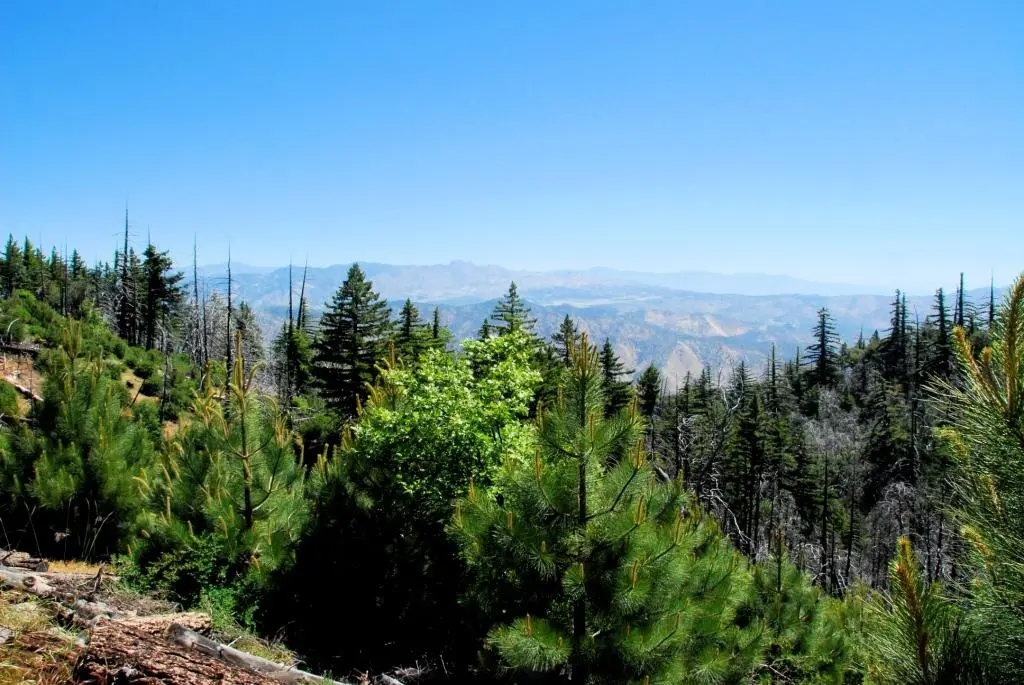
As both landowner and stakeholder within the 15-mile long Volcan Mountain Range, the Volcan Mountain Foundation seeks to understand the conservation values that make the Volcan Mountains such an important area to protect and preserve. Fed by abundant source waters deep below the earth's surface, Volcan's unique and biodiverse upland wildlands offer rich habitat for a wide variety of wildlife.
Understanding the ecology and changing conditions of the Volcan Mountains is essential to informing land management practices and preservation efforts that will keep Volcan wild for all generations.
Collaborations with partner organizations, institutions and agencies are key to robust, scientifically-grounded assessment, monitoring, research and stewardship efforts. Areas of focus are on forest and watershed health and restoration, invasive species management, rare plant surveys, and wildlife and bird monitoring.
Some of VMF's Conservation-Stewardship activities offer opportunities for 'citizen scientists' to participate. If you might be interested in learning more and/or volunteering as part of VMF's Conservation-Stewardship efforts please contact the VMF office at: [email protected] or 760-765-2300.
Saving Oaks--Responding to Goldspotted Oak Borer (GSOB)
We're working to save Volcan's and Julian's iconic, beloved oaks. Won't you please learn more and help us?
Julian to Descanso is at the epicenter of devastation from Goldspotted Oak Borer (GSOB). GSOB is an exotic, invasive insect in southern California that has casued elevated levels of tree mortality for several years.
GSOB represents the most significant threat to red oak species in southern California, and is considered a critical conservation threat to Julian and east San Diego County.
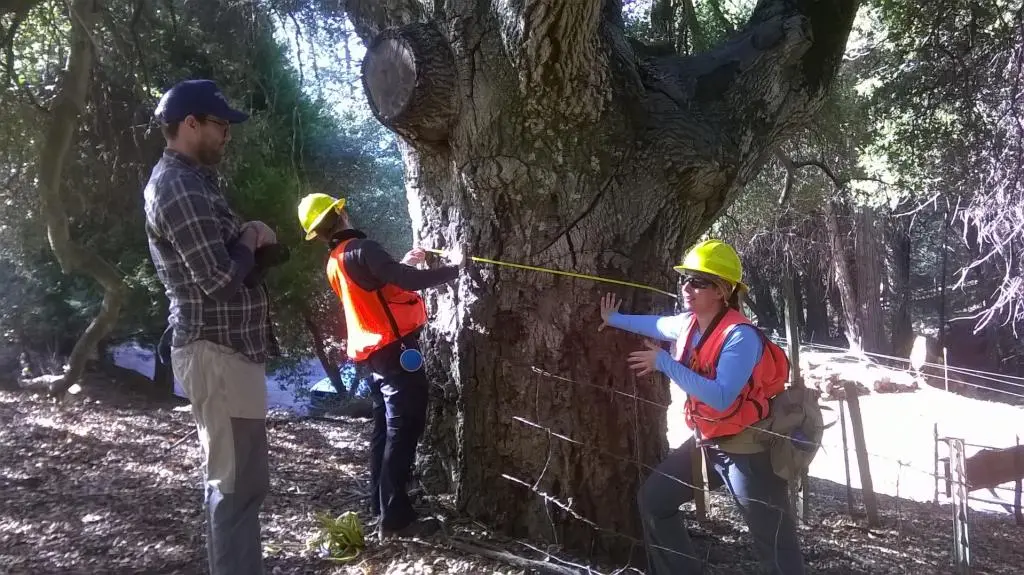
In January 2018 an entemologist, specializing in Goldspotted Oak Borer, and a forest technician from the US Forest Service's Forest Health Protection division surveyed oaks on parts of the 398 acres owned and managed by the Volcan Mountain Foundation. They determined that GSOB is well-established on Volcan Mountain and is causing significant tree mortality to large-diameter oak trees.
They further determined that a GSOB and oak woodlands management plan will be essential for:
- fully assessing and monitoring the health of oaks
- identifying management actions to limit the impact and spread of GSOB
- planning reforestation efforts
Without management intervention, oak mortality will continue to occur at a higher level than what has historically been associated with native insects or diseases in these woodlands.
Combating GSOB and maintaining oaks on Volcan Mountain will be a long-term investment, not only for Volcan Mountain's oaks, but those around Julian and San Diego's backcountry as we work in partnership with teams of land owners and managers.
A forester made a site visit in February and applications are being submitted for funding through forest health programs.
We're going to need your help as we:
- set up trainings to establish oak monitoring teams--Please raise your hand as upcoming calls for volunteers are sent!
- conduct outreach to raise awareness about GSOB's impacts--Please help spread the word
- reach out to backcountry landowners and visitors about the risks of moving oak fuelwood--"Buy It, Where You Burn It"
- raise funds for GSOB and oak woodlands management planning, interventions and reforestation--Please donate to protect the backcountry's previous oaks
- coordinate 'boots on the ground' volunteers to help with reforestation efforts
What we learn and do, and what YOU learn and do along with us, can benefit oaks on Volcan Mountain, on your property and throughout the backcountry.
CLICK HERE TO VOLUNTEER TO HELP SAVE OAKS: VOLCANMT.ORG/VOLUNTEER
From the University of California Cooperative Eduction website:
http://ucanr.edu/sites/gsobinfo/
What is the Goldspotted Oak Borer?
 Goldspotted oak borer (GSOB) Agrilus auroguttatus is an invasive pest contributing to the on-going oak tree mortality occurring on federal, state, private, and local Native American lands in San Diego, Riverside and Orange Counties in southern California. Widespread oak mortality can have severe implications to the environment and human safety. Due to the current and potential impacts to California oaks and communities, public and private organizations are working together in the research, education and outreach efforts related to GSOB pest management.
Badger Research
Badgers Are Finally Back at Volcan Mountain!
Check in periodically for ongoing conservation research information around the Volcan Mountain range.
November 7, 2014 - 2:23pm (see August 2016 update & pix below)
Since 2011 scientists with the US Geological Survey (USGS), with grant funding from the SANDAG TransNet Environmental Mitigation Program (EMP), have been conducting Badger Conservation Research in watersheds connected to the Volcan Mountain range, including along the San Diego and San Dieguito River watersheds. Cheryl Brehme, biologist with the USGS Western Ecological Research Center (WERC) is leading the research and is partnering with Heath Smith, Program Coordinator and handler with the Conservation Canines program out of the University of Washington, and his badger-sniffing Australian cattle dog, Pips.
They recently released a 2 1/2 minute video featuring the summit of San Diego County's Volcan Mountain Wilderness Preserve (VMWP) in their research. (Click here to see the video). The Volcan Mountain Foundation (VMF) is seeking volunteers interested in wildlife monitoring with VMF's Wildlife Imaging Team (WITs). Click here to become a WITs volunteer!
According to Brehme, “This badger research is important because it’s part of a broader effort to measure the success of regional initiatives to preserve and link wildlife habitat. Badger movements are a good indicator of the wildlife connectivity of upland habitats.” Recently a significant badger population has been identified on part of the Volcan Mountain Wilderness Preserve.
Link to 2014 USGS-WERC American badger research report
The researchers are trying to find out more about their status, and where they’re moving among the preserves in the County. Most San Diegans might not think that badgers live in their region. These furry-striped creatures do live here, but they’re rarely seen. Badgers are listed by the California Department of Fish & Wildlife (CDFW) as a species of special concern and very little is known about them. They can travel up to 6 miles a day. It’s the first regional study of its kind. From the research they to seek to identify the location, movement and habitat use of these elusive creatures in San Diego County.
Pips (sometimes called Pipsqueak) is a specially-trained dog, who uses his wonderfully sensitive nose to track scents and signs of badgers. He has found badger scat in burrows. Smith noted that, “Pip can use the wind to his advantage to pick up odors that are moving through the wind, through the environment, then he works into the source of that odor, and then he’ll sit when he finds a sample.” Heath then confirms the sample.
Form the burrows, scientists collect badger hair samples and run DNA analyses to gauge population trends. While there’s plenty of evidence that badgers do live this region, the challenge is to capture images of these elusive creatures, which so far have escaped detection by motion sensor cameras.
The researchers are seeking 'citizen scientists' to be on the look out for badgers signs or sightings. If you happen to see a badger, please notify the USGS or email your sightings to [email protected]. For more information go to: www.werc.usgs.gov/sdbadgers.
Update: August 30, 2016
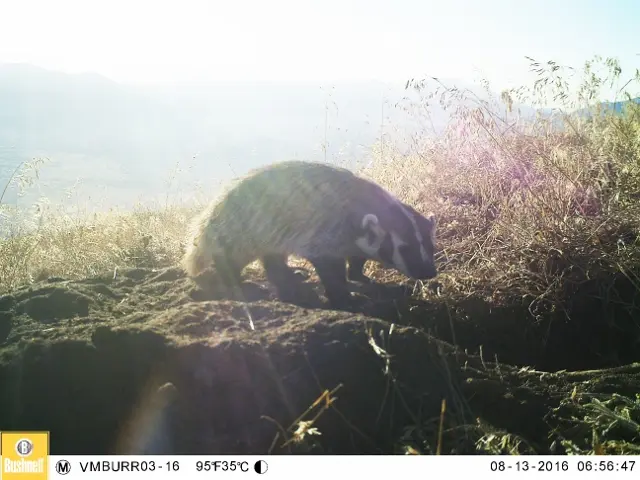
 Researcher, Cheryl, Brehme, with the USGS Western Ecological Research Center (WERC), reports that badgers are finally back at Volcan Mountain! These elusive creatures were here for about a week or so before moving on, and likely traveled long distances to find each other and mate.
Since first recording badger activity (but no actual badgers) in April & May 2014 with Pips, the badger-sniffing dog, and his handler, Heath, there has been zero badger activity...until now--August 2016! Wow, what patiene these researchers have.
Cheryl, and her research partner, Devin, were able to identify three individual badgers by differences in facial markings--Notch, Sideburn and LongNose--and they recorded the following activity:
 A badger was recorded digging out a burrow on Aug. 9- could not identify (no face shot)
- On Aug. 12, Notch was detected and appeared to be scent marking outside of the burrow
- On Aug. 13 at 6AM, Sideburn was detected outside the same burrow (appears young)
- On Aug 13 evening, LongNose was recorded (video and pics) at both burrows
- A badger walked passed the burrows on Aug. 15- could not identify (no face shot)
- No activity since
 Cheryl also noted that it is breeding season for the American badger, and that they have received more reports through the hotline as well. If you have recently seen a badger, fresh burrows, or (yes) a dead badger, you can help this important research work by reporting it.
Phone: 619-225-6458; email: [email protected] and learn more at www.werc.usgs.gov/sdbadgers
Thanks to USGS-WERC for sharing the wonderful pix!
Plant Nerds on Volcan Mountain
August, 2019
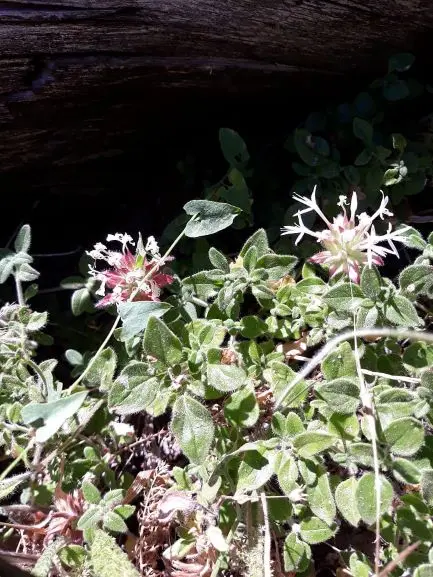
August turned into a plant nerd month on Volcan Mountain. From tiny plants to big trees. The Volcan Mountain Foundation is energized by a handful of emerging partnerships.
Early in the month, VMF had researchers from SDSU's Soils Ecology Restoration Group (SERG) up on the mountain -- an energetic and enthusiastic group of self-described "plant nerds". They met with VMF Executive Director, Colleen Bradley and VMF Conservation-Stewardship committee co-chair, Dr. Michael Lang. Having largely worked along coastal and desert areas around Southern California, the SERG team was excited to explore the mixed conifer forests and oak woodlands of the Volcan Mountain uplands. They were especially looking forward to seeing Volcan's big cone Douglas firs -- a rarity at the southern end of its range on Volcan.
We were all excited to see another of Volcan's rarities -- San Felipe Monardella (part of the mint family) -- in flower, and also see so much native milkweed in bloom. Our native milkweed is only found at high elevations, and is an important food source for monarch butterflies.
As VMF and SERG explore partnership and research opportunities, responding to the very concerning degree of oak mortality that Volcan and nearby upland areas are experiencing is a high priority. Controlling the goldspotted oak borer -- introduced through movement of firewood in the early 2000s and since contributed disproportionately to a dismaying loss of oaks – along with oak propagation and restoration will also contribute to wildfire fuel reduction, resiliency to wildfire and overall forest health. Oaks are a keystone species that a large variety of wildlife depend on.
Our long-time partners, the San Dieguito River Valley Conservancy and the San Dieguito River Park, are part of a shared effort to address oak mortality and forest health on Volcan and its foothills.
With this past winter's abundant rains, the local mountains are experiencing a mast year, or mast seeding, with conifers producing copious amounts of cones. In partnership with a geneticist at the US Forest Service, a member of VMF's Conservation-Stewardship committee and Ambassadors Circle, Cody Pettersen, is leading cone harvesting for big cone Douglas firs on VMF's upper parcels near the south end of Volcan, as well on another 300 acres near the north end of the Volcan Mountains. The harvested cones will be propagated by the forestry service for future big cone Douglas fir restoration efforts.
As the month comes to a close, another new partnership with the San Diego chapter of the California Native Plant Society (CNPS-SD), developed by VMF Conservation-Stewardship committee co-chair, Valérie Cournoyer, has resulted in an upcoming rare plant survey on Volcan scheduled for Sunday, September 1. As described by CNPS-SD President, Justin Daniel, "(VMF's) Volcan Mountain Nature Center and trails above it are about as wild as the Peninsular Range gets so close to civilization." This brings another excited group of "plant nerds" to Volcan Mountain and an opportunity to reinforce the understanding of Volcan's uniquely biodiverse habitat.
For more information about the Volcan Mountain Foundation and events and activities on around the Volcan Mountains, visit: VolcanMt.org
Private Property Rights Protection Notice
Adopted by Volcan Mountain Foundation Board of Directors
December, 2018
STATEMENT OF PRINCIPLE: The Volcan Mountain Foundation (VMF), a nonprofit foundation respects private property rights and has pledged not to infringe upon those rights to implement its goals and objectives. To ensure that private property rights are respected, VMF has adopted the following specific guidelines for private property rights protection:
Eminent Domain: VMF will not recommend nor participate in a hostile condemnation. When it acquires property or participates in property acquisition as a facilitator, VMF supports compensating property owners for the fair market value of their property.
Focused Planning Area: The focused planning area for the Volcan Mountain Foundation is a planning boundary containing both private and public land in the vicinity of the Volcan Mountains range. The focused Planning Area encompasses the ridges and foothills as well as the viewshed of the Volcan Mountains range. It is consistent with the VMF mission to facilitate acquisition of land from willing property owners when that land is deemed to have great environmental value.
Farming and Ranching: VMF supports the continued use of private property for farming and ranching purposes. The Volcan Mountain Foundation encourages agriculture as a substantial portion of land use in the Focus Planning Area and continued ranching consistent with historical use of the land. VMF has not and will not interfere with a property owner's rights or ability to farm or conduct ranching operations.
Energy Project Position Notice
Adopted by Volcan Mountain Foundation Board of Directors
March, 2021
STATEMENT OF PRINCIPLE: The Volcan Mountain Foundation (VMF), a nonprofit foundation, supports renewable energy production, which provide electricity with low carbon dioxide emissions. It takes a position opposing large-scale solar and wind energy project within its Focus Planning Area (FPA), while encouraging small residential installations as well as large-scale projects in other areas with low conservation value. To ensure that its position is clear, VMF has adopted the following specific guidelines for energy project development:
Large-Scale Development: The VMF will actively oppose any large-scale development within its FPA, including industrial-size alternative energy projects.
Small-Scale Private Implementation: The VMF is not opposed to landowners installing small-scale solar or wind power projects on private property within the FPA to meet the needs of the owner.
The mission of the VMF is to preserve the Volcan Mountain Range in its natural state for all generations. Our mission thereby precludes any industrial-size alternative energy projects within our FPA.
Fact Sheet for Landowners
The Volcan Mountain Foundation respects private property rights and has pledged not to infringe upon those rights to implement its goals and objectives. Since 1989, through facilitation efforts of the Volcan Mountain Foundation and its partners, more than 19,000 acres of land have been acquired from willing sellers, bringing conserved land within the range to approximately 42,000 acres.


VMF Wildlife Imaging Team (WIT)
Keeping Our WITs About Us! VMF's Wildlife Imaging Team
In 2015 the Volcan Mountain Foundation started the Wildlife Imaging Team to learn about the wildlife on Volcan Mountain. Motion-detecting cameras were placed in different habitats including the riparian zone of the Santa Ysabel Creek ― the headwaters of the San Dieguito River. The motion-detecting cameras are managed by dedicated volunteers who download and review the images every month and enter the information into a database. While the program cannot track specific animals, the data allows VMF to understand the presence of different species at different times of the year.
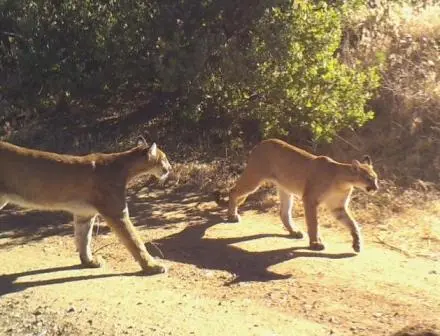
What did we learn? That the Volcan Mountains are home to diverse wildlife. In addition to mule deer, there is bobcat, coyote, gray fox, western squirrel, raccoon, opossum, and various birds who live on this 15-mile long range. Some of the most exciting photos captured are of mountain lions.
Since San Diego County wildlife habitats and corridors continue to shrink due to development, we know that the Volcan Mountains are one of the last places in the county that support larger mammals as well as smaller rare animals such as the western spotted skunk, badger, and ringtail. The information obtained from the program continues to help to make the case for land preservation and the fight against species disease and extinction.
The Volcan Mountain Foundation shares its gathered information with other organizations including the San Diego Management and Monitoring Program. Click here to see WIT's findings and data analysis on SDMMP's website.

The Volcan Mountain Foundation wishes to thank the volunteers who have spent countless hours making this program possible, including Susan and Bill Carter who led the way for 15 years as well as Angie Brenner, Judy Kemp, Alan Marvin, Richard Louv, and Don Whitson for their dedication and love of nature. Also, VMF wishes to thank Amy Eppert and Professors Dr. Mike Mooring and Dr. Ryan Botts of Point Loma Nazarene Unitversity.
VMF's Wildlife Imaging Team (WIT)
Keeping Our WITs About Us
Click here to volunteer with VMF's Wildlife Imaging Team! 
In 2015 a group of interested VMF volunteers, inspired by a library presentation on mountain lions given by State Parks biologist Mike Puzzo, came together to form VMF's Wildlife Imaging Team, or as they like to refer to themselves: the WITs.
 Kathleen Beck, at the time, VMF's Education Coordinator, had coordinated the presentation, and a year earlier was inspired by the mountain lion photos captured by the camera of VMF neighbor Don Whitson. She led VMF's efforts to purchase six remote trail cameras to learn about wildlife on the nearly 400 acres of Volcan Mountain that are owned and managed by the Volcan Mountain Foundation. The cameras were placed in different habitats including the riparian zone of the Santa Ysabel Creek headwaters.
What could be learned?
In addition to the many deer and turkey, there were bobcat, coyote, gray fox, squirrel, raccoon, opossum and various birds. Some of the most exciting photos captured were of mountain lions roaming the upper property trails.
Maintaining and monitoring the cameras that were monitoring the wildlife was done with steadfast persistence by Ms. Beck, Ms. Fry, and Kris Jacobsen, then a new VMF Board Member. It was a time-consuming effort for the group of three, and they were also working out the best practices for collecting, organizing, storing and analyzing images.
 The old adage of many hands make light work was exactly what this wildlife monitoring project needed, and several volunteers came forward at that January library presentation to establish the core of the Wildlife Imaging Team. In addition to Beck, Fry and Jacobsen, there was Bill and Susan Carter, Mark and Sophia Lowder, Alan Marvin, Jerry and Maryann Miller, Jane Santorumn, and Don Whitson that formed that core group who continuing the steadfast maintenance and monitoring of the cameras.
About the same time, Mike Puzzo connected VMF with Point Loma Nazarene University Conservation Biology professor, Dr. Mike Mooring, who since 2010 has been leading his summer research students to Costa Rica to conduct field research on the large mammals of the Talamanca cloud forests. Dr. Mooring was looking for a field study site in San Diego where his students could learn how to conduct wildlife monitoring research with remote camera traps during the school year.
 That was the start of what is becoming a beautiful partnership between the Volcan Mountain Foundation and Point Loma Nazarene University. Dr. Mooring's students conducted research over a six-week period in the spring of 2015 and submitted an analysis of that research to VMF.
The goal is to get a coordinated wildlife monitoring framework with the volunteers and partners on VMF-owned property. The broader goal is to see ongoing wildlife monitoring activities connected throughout lands owned and managed by different agencies throughout the 15-mile long Volcan Mountain Range and as well as parts of its adjacent watersheds.
Documenting the presence (or absence) of keystone, umbrella, and indicator species, like deer and mountain lion (and badger!), can inform not only about the health of the species but also the health of Volcan Mountain habitat. This information can provide important guidance for conservation management and restoration activities
Although there have been biological surveys done around other areas of Volcan Mountain (mainly prior to the major wildfires) as well as informal observational reports of commonly seen animals around VMF-managed property, confirming the presence of what species make their home on VMF property will be key to the long-term protection of those species and the habitat they need to survive.
The Wildlife Imaging Team is an exciting opportunity to monitor and study the wildlife that make their home on Volcan Mountain...please come along on the exploration!
VMF Wildlife Imaging Team (WIT) Volunteer Form
The Volcan Mountain Foundation's Wildlife Imaging Team (WITs) maintains six wildlife cameras to gather information on wildlife movements on Volcan Mountain. The WITs need additional volunteers to help with:
- maintaining the camera sites
- retrieving camera cards from each of the six cameras on a monthly schedule
- downloading the images to a computer that the WITs maintain at VMF's Volcan Mountain Nature Center
These activities involve approximately 2-3 hours per volunteer per month. The scenery is beautiful, the images are inspiring, and the work is critical to conserving wildlife on Volcan Mountain. Current WITs volunteers are available to train new recruits and no previous experience with wildlife cameras is required.
Please join the team today and help us keep our WITs about us!
Yes, I'd like to become part of VMF's Wildlife Imaging Team:
Complete this form
Fields marked with an asterisk (*) are required.